

Financial Literacy · a two-hour workshop

Two hours. Your team. Your actual financials.
the workshop
When your whole team understands the numbers, better decisions get made everywhere — not just in the leadership meeting.
Most people weren't taught to read financial statements. They run departments, manage budgets, and make decisions that move real money — often without a clear picture of how those decisions show up in the company's finances. That's not a knowledge failure. Nobody ever explained it to them in plain language.
THE PREMISE
A financially fluent organization is a more capable one.
That's what we do. We teach the numbers from the top of the organization to the front line, in words anyone can follow. No jargon, no assumed background, no making anyone feel behind. Just a clear, confident understanding of what the numbers mean and why they matter.
People spot problems sooner, ask sharper questions, and understand how their own work connects to the health of the business. And when everyone can read the numbers, transparency stops being a value you talk about and becomes one you actually live — which is exactly the kind of culture we believe makes companies stronger.
WHAT WE'RE REALLY AFTER
We're not trying to turn your team into accountants.
The goal is more useful than that: build enough literacy to put what people already see and feel into context — and spark the curiosity to keep learning. When someone understands the handful of numbers that describe their world, finance stops being intimidating and starts being interesting.
Before
Anxiety
- Nodding along without following
- Avoiding the budget conversation
- Feeling behind, quietly
After
Curiosity
- Asking the next question
- Connecting your work to the P&L
- Watching three to five numbers


Not a lecture — a working session
Every term we bring to the workshop is surrounded in a discussion.
The workshop is highly interactive and hands-on, built around your company's real financials. We connect the dots between the numbers on the page and the work your team does every day, so the concepts land in a context people actually recognize.
Financials can feel overwhelming — for most people, that's the honest starting point, and we meet them there. Rather than firing the whole dictionary at everyone, we help each person hold onto three to five terms they can routinely keep an eye on: the handful that tell them what really matters and how the company is performing.
That's how comfort gets built — not by memorizing everything, but by mastering the few things that count and growing from there.
Before we ever step in the room
Every business has its own language — and its own quiet communication killers.
The biggest one is acronyms: the shorthand that half the team uses fluently and the other half nods along to without really knowing what it stands for. Ahead of the workshop, we dig into your company's specific jargon, lingo, and acronyms, so the session speaks your language and clears up the terms that have been silently tripping people up.
The acronyms half your team can't decode
EBITDA? AR / AP CapEx OpEx WIP GMROI RevPAR FTE SG&A COGS ARR CAC LTV DSO DPO Y/Y Q/Q
The pre-work glossary, tailored to your business
Sent before day one

A TASTE OF PLAIN LANGUAGE
Five terms that get thrown around constantly, explained the way we'd explain them to your team.
This is just the surface. The workshop goes deeper — and makes it specific to your business.
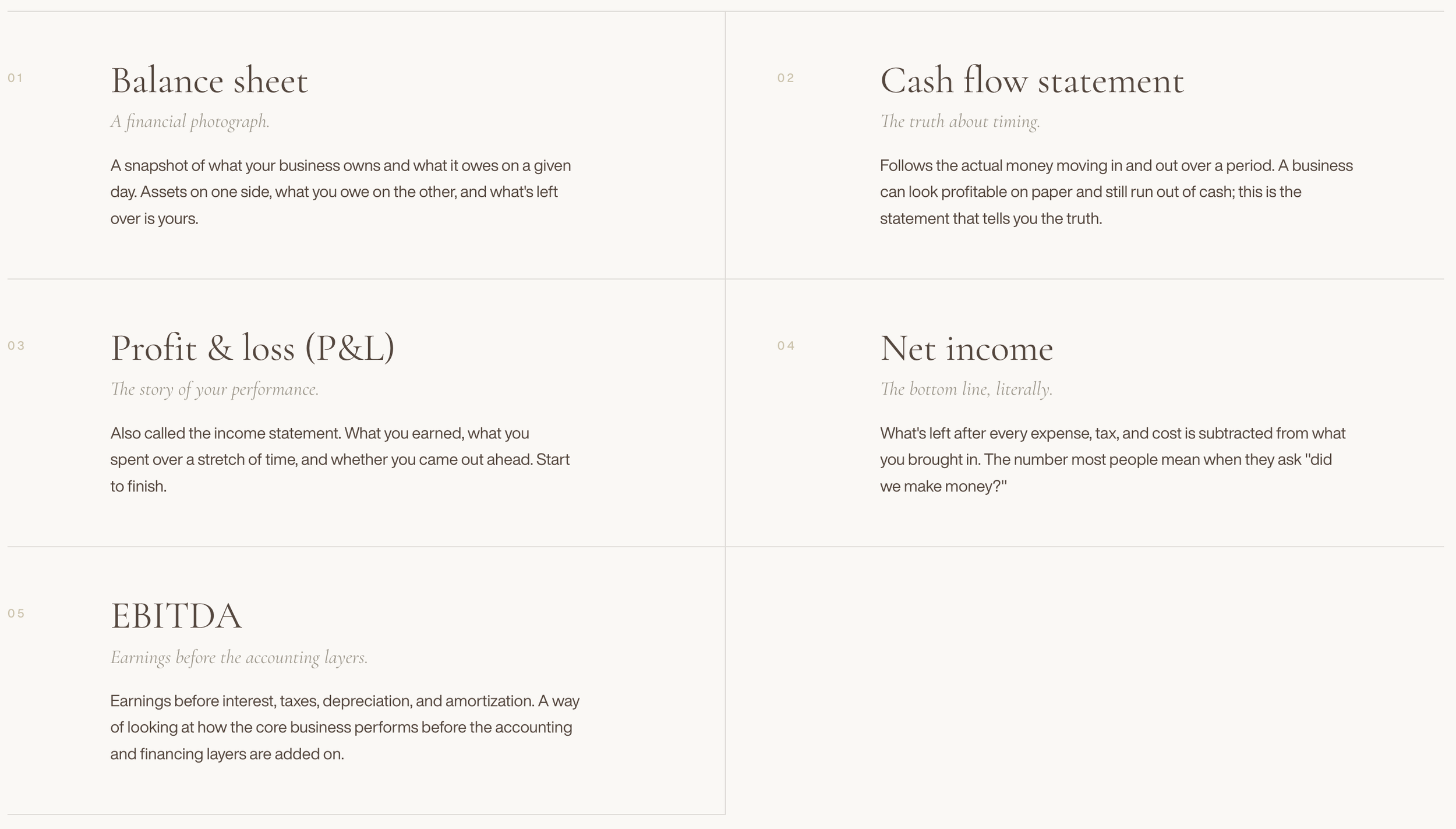
- 01
Balance sheet
A financial photograph.
A snapshot of what your business owns and what it owes on a given day. Assets on one side, what you owe on the other, and what's left over is yours.
- 02
Cash flow statement
The truth about timing.
Follows the actual money moving in and out over a period. A business can look profitable on paper and still run out of cash; this is the statement that tells you the truth.
- 03
Profit & loss (P&L)
The story of your performance.
Also called the income statement. What you earned, what you spent over a stretch of time, and whether you came out ahead. Start to finish.
- 04
Net income
The bottom line, literally.
What's left after every expense, tax, and cost is subtracted from what you brought in. The number most people mean when they ask "did we make money?"
- 05
EBITDA
Earnings before the accounting layers.
Earnings before interest, taxes, depreciation, and amortization. A way of looking at how the core business performs before the accounting and financing layers are added on.
And two more
You'll hear these constantly.
Cash reserves
The cushion.
Money set aside to cover the lean stretches, the surprises, and the opportunities you'll want to move on quickly. How much is enough is one of the most important questions a business can ask itself.
CapEx
Capital expenditures.
Spending on the big, long-lived things: equipment, buildings, technology, the assets that keep working for years. Knowing the difference between CapEx and everyday operating costs changes how you read almost every number around it.

your five depend on your world
A restaurant, a non-profit, and a university are each watching a different short list.
The terms above are a great starting point for most businesses — but the right five aren't the same for everyone. Part of the tailoring we do is figuring out which handful actually matters for you.

The same goes across industries: a manufacturing team, a professional services firm, and multi-location wellness services company - Mare + Co. provides a glossary built around the numbers that run their world.
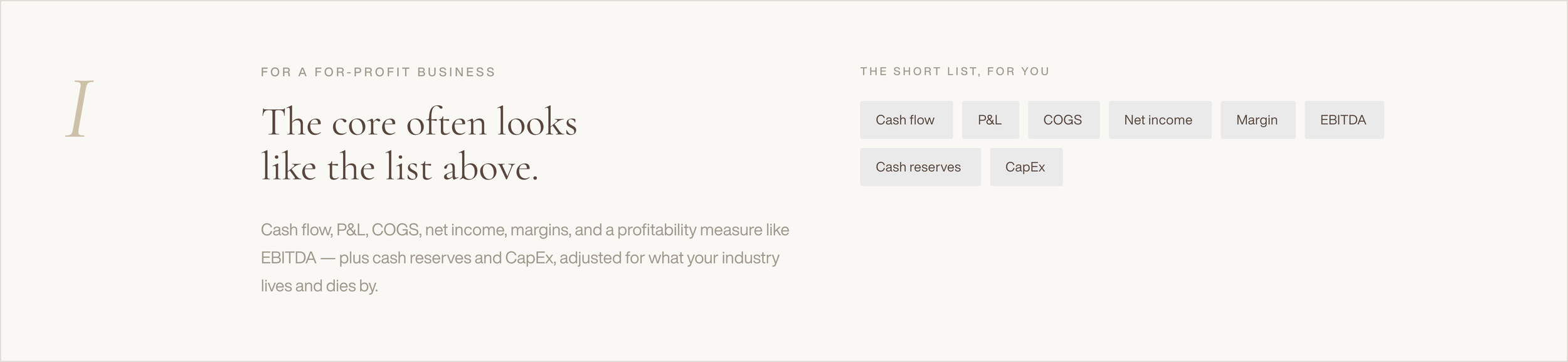
For a for-profit business
The core often looks like the list above.
Cash flow, P&L, COGS, net income, margins, and a profitability measure like EBITDA — plus cash reserves and CapEx, adjusted for what your industry lives and dies by.
The short list, for you
- Cash flow
- P&L
- COGS
- Net income
- Margin
- EBITDA
- Cash reserves
- CapEx
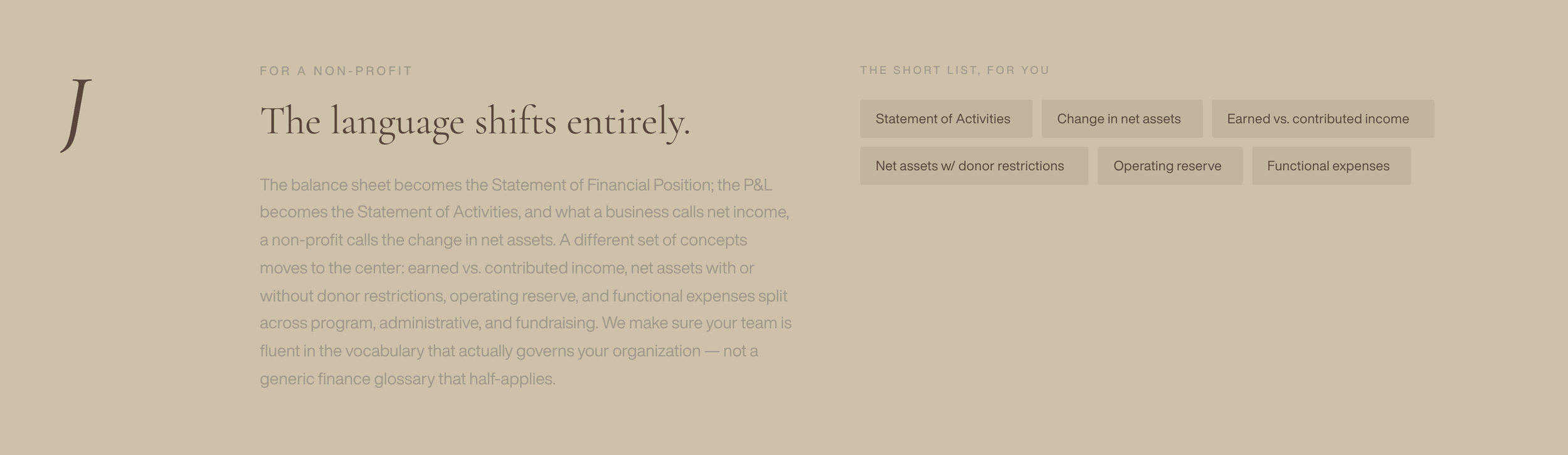
For a non-profit
The language shifts entirely.
The balance sheet becomes the Statement of Financial Position; the P&L becomes the Statement of Activities, and what a business calls net income, a non-profit calls the change in net assets. A different set of concepts moves to the center: earned vs. contributed income, net assets with or without donor restrictions, operating reserve, and functional expenses split across program, administrative, and fundraising. We make sure your team is fluent in the vocabulary that actually governs your organization — not a generic finance glossary that half-applies.
The short list, for you
- Statement of Activities
- Change in net assets
- Earned vs. contributed income
- Net assets w/ donor restrictions
- Operating reserve
- Functional expenses
For higher education
A dialect in a class of its own.
Few people inside the institution fully speak it. Tuition discount rate, net tuition revenue, restricted endowments and their draw, fund accounting, auxiliary revenue, FTE-driven budgeting: a vocabulary dense enough that faculty, staff, and even trustees often nod along without shared understanding. This is exactly the kind of environment where a common language pays off the most — and a setting we know well.
The short list, for you
- Tuition discount rate
- Net tuition revenue
- Endowment draw
- Fund accounting
- Auxiliary revenue
- FTE-driven budgeting
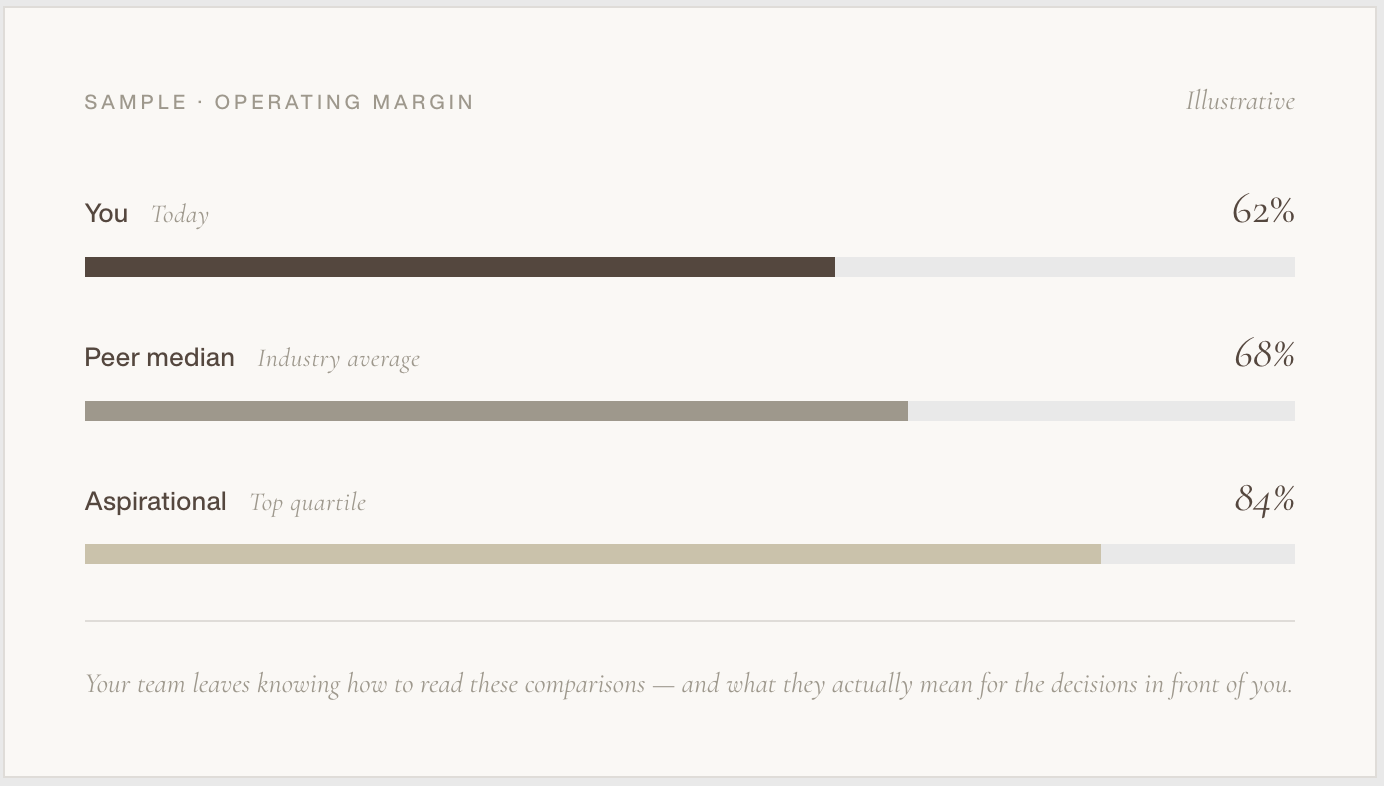
Sample · Operating margin
Illustrative
You Today
62%
Peer median Industry average
68%
Aspirational Top quartile
84%
Your team leaves knowing how to read these comparisons — and what they actually mean for the decisions in front of you.
knowing where you stand
Reading your own numbers is half the work. The other half is reading them in context.
We also touch on a few benchmarking terms and metrics — because every business benefits from scanning the landscape: understanding where you sit compared to your peers, and to the aspirational peer group you're working to join. We give your team a feel for how that comparison works and why it matters.
The two-hour workshop
A focused, two-hour working session — interactive, grounded in your own financials, tailored to how your business actually makes and spends money.
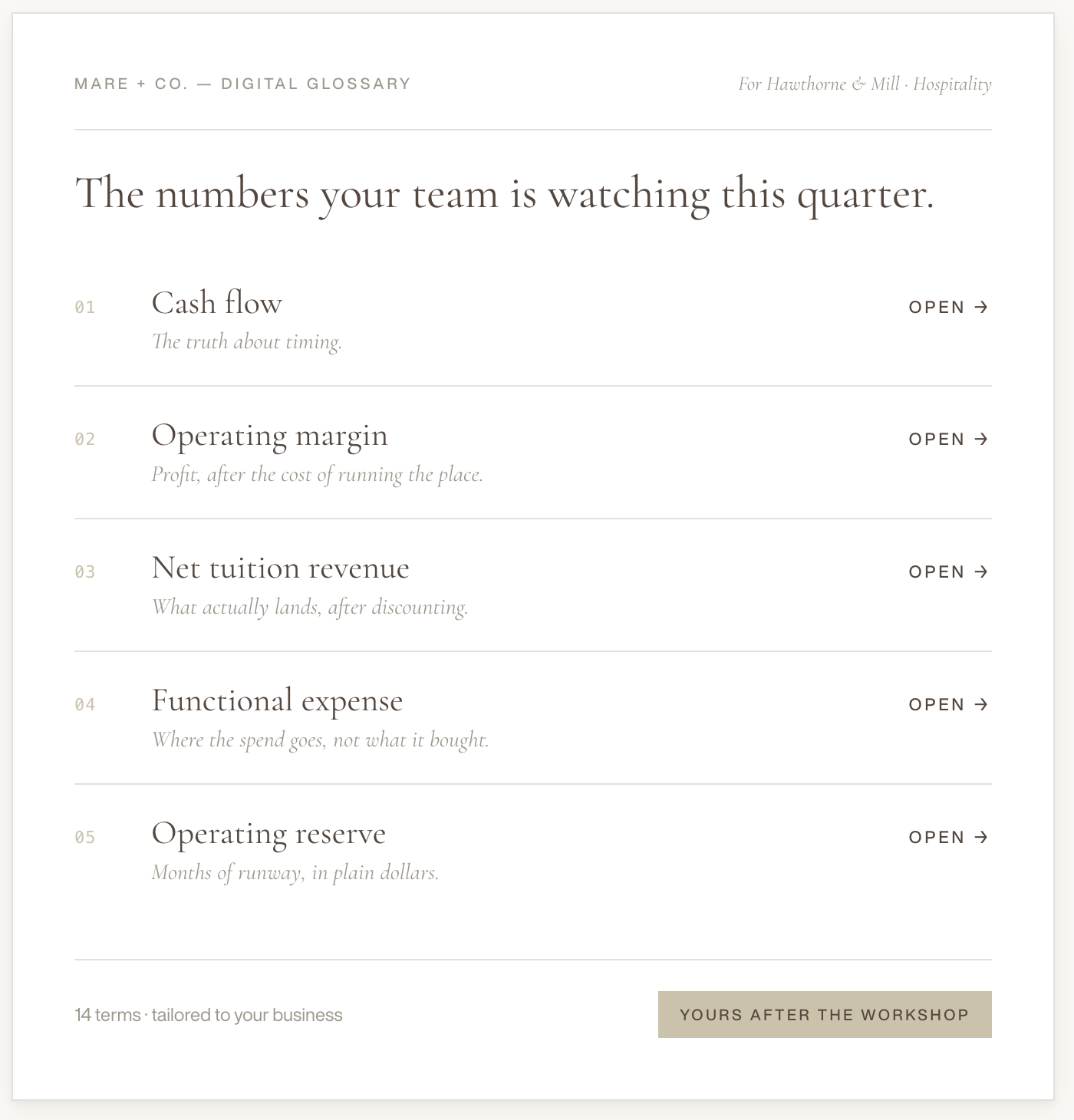
Mare + Co. — Digital glossary
For Hawthorne & Mill · Hospitality
The numbers your team is watching this quarter.
- 01Open →
Cash flow
The truth about timing.
- 02Open →
Operating margin
Profit, after the cost of running the place.
- 03Open →
Net tuition revenue
What actually lands, after discounting.
- 04Open →
Functional expense
Where the spend goes, not what it bought.
- 05Open →
Operating reserve
Months of runway, in plain dollars.
14 terms · tailored to your business
Yours after the workshop
It works as a standalone engagement for a team, a leadership group, a board, or a peer or association audience. It's also a natural first step into a deeper relationship with us — once a team shares a common financial vocabulary, every conversation that follows gets easier.
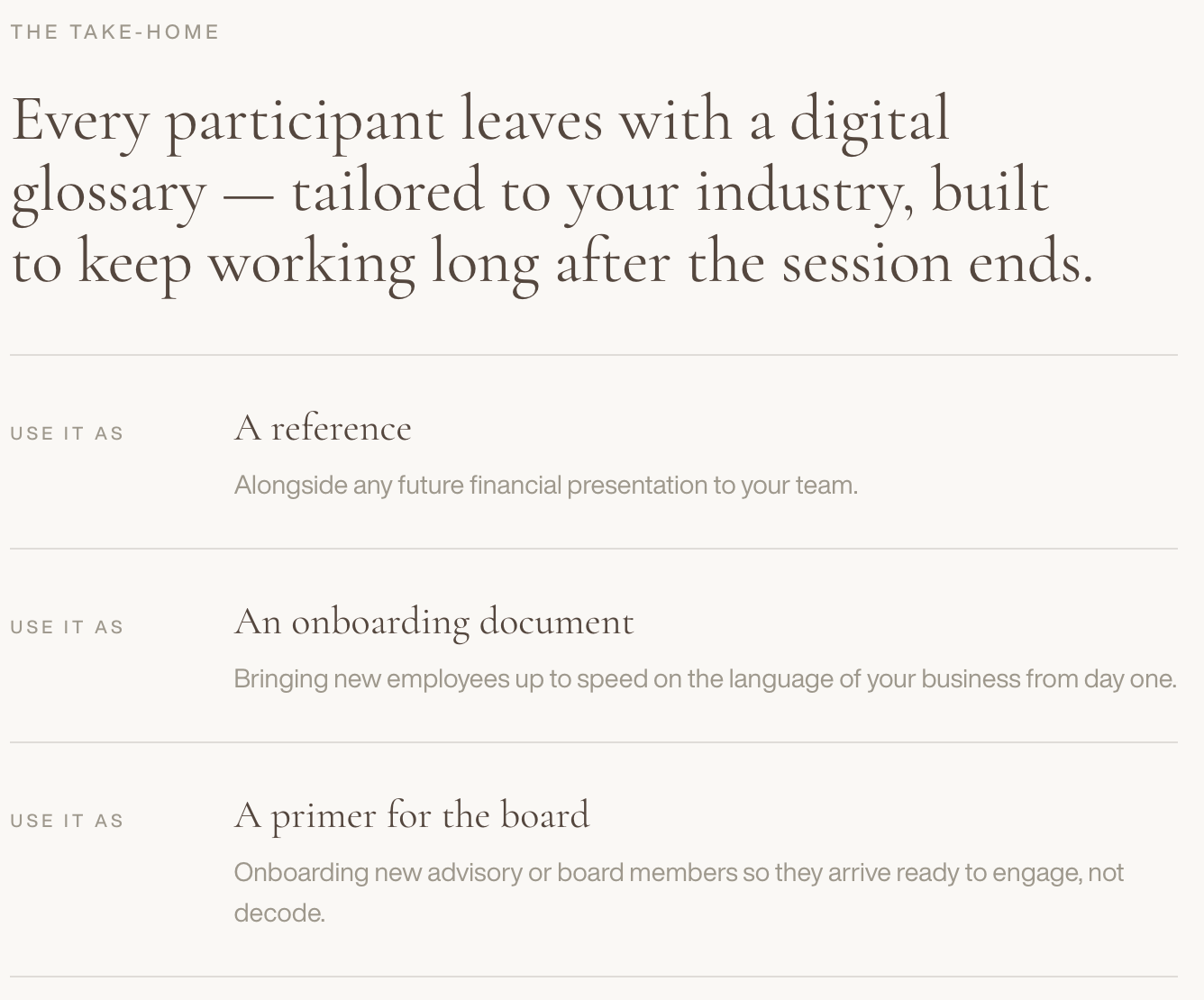
The take-home
Every participant leaves with a digital glossary — tailored to your industry, built to keep working long after the session ends.
- Use it as
A reference
Alongside any future financial presentation to your team.
- Use it as
An onboarding document
Bringing new employees up to speed on the language of your business from day one.
- Use it as
A primer for the board
Onboarding new advisory or board members so they arrive ready to engage, not decode.
Common questions
-
A two-hour session that teaches your team the financial terms they hear every week and what those terms mean for their own decisions. We are not turning your team into accountants; we are giving them the language to act on the numbers.
-
Anyone whose decisions touch revenue or cost: managers, department heads, and front-line leads. When the whole team understands the numbers, better decisions get made everywhere, not just in the leadership meeting.
-
The workshop covers the financial terms that get used constantly but rarely explained, in plain language and with real examples. We show how a restaurant, a nonprofit, and a university each watch different numbers, so your team sees how the same concepts apply to your own business.
-
Yes. Reading your own numbers is half the work, so we bring your financials into the room, with your permission, and show your team how to read them in context.
Bring financial literacy to your team
Reach out and we'll walk you through what the workshop covers — and pricing for your group.
Tell us about your team and the language you'd like everyone to share. We'll come back with scope, scheduling, and a fixed quote within one business day.
Contact us about a workshop.
Two hours. Your team. Your actual financials. Built around the words your business already uses — and the words it should.
SEE HOW THESE NUMBERS COME TO LIFE →
Custom Dashboards
Once a team shares a common vocabulary, the natural next question is: where can we actually see these numbers? In real-time. At a regular cadence. That’s what we build next.